






The Cephalopod term refers to highly evolved species of molluscs, they stand out by their intelligence and ability to change color and adapt to the environment. The cephalopods have a visibile head that contains eight or ten tentacles equipped with a suction cup in order to retain its preys. When they feel danger, they can discharge ink to disturb the water and conceal their escape. The main cephalopods species that are available in Moroccan seas are octopus, squid and cuttlefish; Octopuses have 8 tentacles of the same length, squid and cuttlefish have 10 tentacles (8 short and 2 very long).
The fishing techniques used to catch these species are the demersal trawl, handliners, pot fishing and lamparo nets.
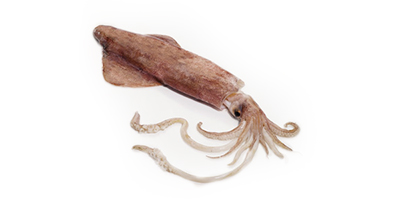
SQUID : LOLIGO VULGARIS
This cephalopod has several names: squid, real squid and encomet(Another name for squid). It has an elongated
and pointed body at the level of its posterior edge, it also has two lateral fins and has a very thin internal bone that
looks like a feather. Its head, quite distinct, has 10 muscular arms equipped with suction cups. Two of these arms
are longer than the rest as they facilate the capture preys.
The common length of its mantel is between 15 and 25 cm with a maximum length of 40 cm.
The squid is a neritic, semi-pelagic species that make seasonal vertical migrations between 20 and 250 m of
depth.
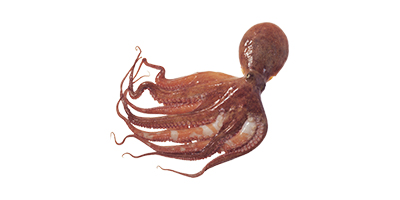
OCTOPUS : OCTOPUS VULGARIS
Also called Octopus, Rottala, Azaiz; it is the most evolved species of molluscs. The octopus has a soft, globular
body which shrinks slightly at the junction with its head. It is covered with mucus and has no fin and no inner shell.
It has eight arms that are located around its mouth whose sides are longer than the ventral and dorsal, each of
them have two rows of suction cups.
The common length of its mantel is 10 to 20 cm.
It is a coastal benthic species that lives up to 100 m deep in the rocky and sandy bottoms. It’s solitary and makes
seasonal migrations.

CUTTLEFISH : SEPIA OFFICINALIS
It’s a rather bulky cephalopod. Its mantel covers the inner shell or sepia and is striped, it has a common length of
15 to 25 cm with a maximum of 35cm. Its head has 10 tentacles with suction cups around its mouth, two of which
are longer and more retractile. The suction cups make 5 to 6 rows, the ones in the middle are moderately larger.
It’s a demersal, neritic species that likes mixed, sandy and muddy bottoms as well as seagrass from the coast up
to about 150 m depth, it is more commonly found in less than 100 m.