






White fish refers to multiple species of demersal fish. The most traded species in Morocco are sea bream, sargo, sole, pagellus, hake, John Dory ... etc.
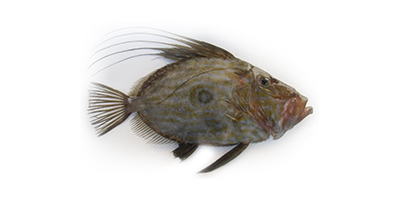
JOHN DORY: ZEUS FABER
The John Dory is a noble fish with a strong laterally compressed body, it has common a length that goes between 10 and 50 cm and a maximum length of 68 cm. Its body is gray colored, along brown and golden glints and a large black spot visible in the middle of the flanks. The dorsal and caudal fins have double bony scutes at their base.
It is a demersal species that lives alone (or in small groups for the young ones). It lives in depths of 400 meters but is more commonly found between 150 and 300m in muddy bottoms.
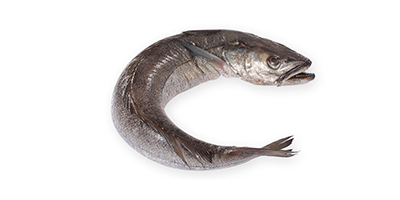
EUROPEAN HAKE: MELUCCIUS MERLUCCIUS
The European hake has a much-tapered shape, it has a bluish gray color, lighter flanks and a silvery white belly.
Its head is bulky and pointed with relatively large eyes. It has two dorsal fins that include only flexible rays, the first fin is triangular and short while the second is long. The anal fin is also very long.
It has a common length of 12 to 60 cm and a maximum length of 130 cm.
It is a demersal species that lives in depths of 70 to 370 m, it is well known to be found on the borders of the continental slope.
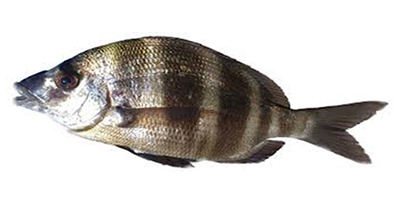
ZEBRA SEABREAM: DIPLODUS CERVINUS CERVINUS
Also called Boubradaa, Sargho, Berdeil, Aberdag or Sar drum, it is a species of the sparidae family that stands out by large whitish lips, a dark band crossing its eye and 5 dark bars on the back.
Its common length is between 20 and 35 cm and its maximum length is 55 cm.
It is a demersal species that lives in rocky and muddy bottoms between 25 and 300 m of depth. It is more commonly found in less than 100 m of depth.
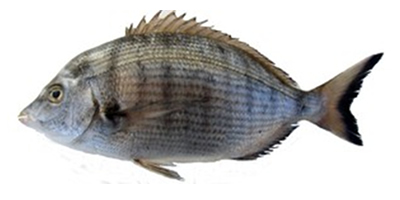
SHEEPHEAD BREAM: DIPLODUS PUNTAZZO
Also called Boubradaa or Sargho, it stands out by the presence of 6 or 7 vertical stripes that are very dark alternating 7 other lighter stripes and a dark spot which forms a ring on the caudal peduncle.
Its common length is between 15 and 30 cm, its maximum length is 60 cm.
It is a gregarious, coastal demersal species that lives in sandy and rocky bottoms as deep as 150 m. The young ones live in coastal waters and enter the brackish water while the adults stand in the area of the surf zone.
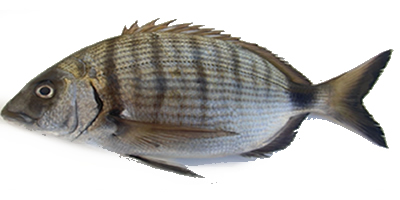
SARGO: DIPLODUS SARGUS SARGUS
This fish has a laterally compressed body, its head is small compared to the rest if its body.
It stands out by the presence of a dozen of gray transverse lines on its back as well as on the top of its flanks, the presence of a black band that crosses the caudal fin and the presence of a caudal spot that does not reach the inferior border.
It is a hermaphrodite species, with a common length of 15 to 30 cm and a maximum length of 45 cm.
It’s a demersal fish that lives in rocky and sandy bottoms, it lives near the rocks for as deep as 50m.
The young, euryhaline, ones enter brackish waters and lagoons in spring and return to sea in autumn to seagrass.
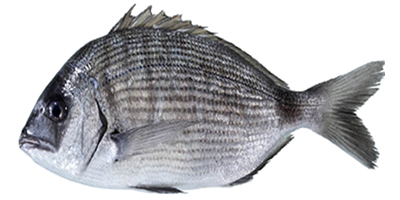
MOROCCAN SARGO : DIPLODUS SARGUS TYPICUS CADENAT
Also called Boubradaa, Sargho, Charghi, Hambal, its common length can reach up to 25 cm and a maximum of 45 cm, it has the characteristics of the common sargo but is distinguished by the presence of 9 bands alternately light and dark.
It is a coastal demersal species that lives in shallow rocky bottoms for as deep as 100 m. It’s more commonly found at 50 m of depth.
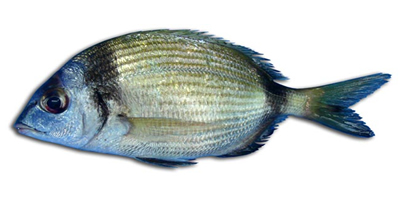
COMMON TWO-BANDED SEABREAM: DIPLODUS VULGARIS
Also called Saghro, Boubradaa or Addad. It differs from the common sargo by the presence of a broad black band on the neck of its dorsal at the beginning of the pectoral as well as a dark spot in the form of a ring on the caudal peduncle. Several horizontal golden lines are also present on the back.
Its common length is 18 to 25 cm with a maximum length of 45 cm.
It is a coastal demersal species that lives in rocky or sandy bottoms for as deep as 200 m.
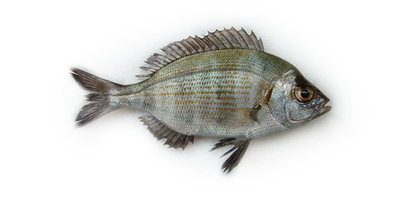
BLACK SEABREAM : SPONDYLIOSOMA CANTHARUS
Also called Griset or Zigzag. It is a fish that has a laterally compressed oval body and is dorsoventrally symmetric. It’s silver-gray but the color is lighter on the belly with golden/yellow discontinuous longitudinal lines.
Its length goes between 20 and 30 cm for a maximum length of 60 cm.
It is a demersal species that lives in rocky, sandy . Adults live from up the coast to 300m deep while the young ones go as down as 50m of depth
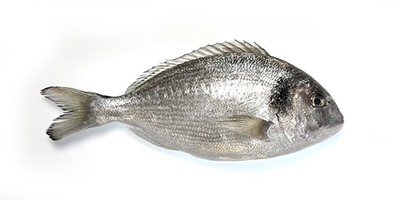
GILT-HEAD BREAM: SPARUS AURATA
The gilt-head bream has a high laterally compressed gray-silver body with a large black spot at the beginning of the lateral line and a golden bar between the eyes, hence its nickname "Belle aux sourcils d’or" (Golden eyebrows beauty).
It has a common length of 20 to 50 cm and a maximum length of 75 cm.
It is a demersal species, living on seagrass, sandy and rocky bottoms and in surf zones as well. The adult habitat is located up to 200 m deep while the young ones live in as deep as 30 m.
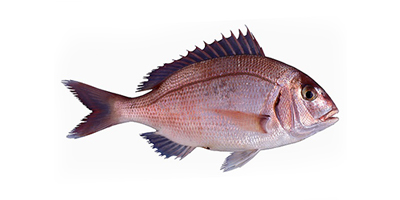
BLACKSPOT SEABREAM : PAGELLUS BOGARAVEO
Its body is slightly more thickset. Its eyes are large, hence the nickname "Big eyes".
It stands out by the large black spot located at the beginning of the lateral line, on top of and just behind the operculum as well as the more or less bright pink fins.
Its common length is between 15 and 50 cm, for a maximum length of 70 cm.
It is a demersal species that likes multiple deep bottoms (rocky, sandy, and muddy), it lives from the surface to as deep as 800 m. The young ones live more in the coastal area, adults on the other hand live in the continental slope.
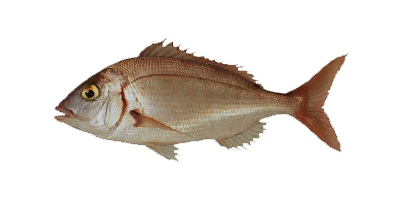
COMMON PANDORA : PAGELLUS ERYTHRINUS
Also called Coq rouge (Red Rooster), Brecha, Amzough, Breka, Cachoukou, Pargo, Boubrahim.
It has a high and laterally compressed body, with a maximum length of 90 cm and a common length of 20 to 50 cm. Its head is quite voluminous and rather sharp with very developed pectoral fins.
The common pandora is silvery pink, dotted with small blue spots on the back and in the beginning of the flanks. Its belly is white-silvery and the top of its head is darker than the rest of its body. Its fins are translucent pale pink.
This species stands out by the presence of red spots on the upper border of the operculum and at the base of the pectoral fins.
It is a demersal species that lives in multiple deep bottoms (rocky, gravely, sandy and muddy) for as deep as 320 m but is more commonly found between 20 and 100 m. The adults are more found offshore while the young ones are closer to the coast.
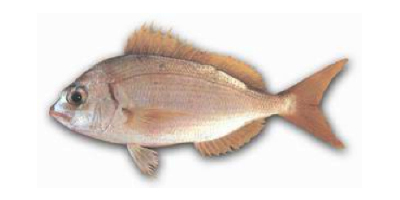
RED PANDORA : PAGELLUS BELLOTTII BELLOTTII
Also called Besugue, the red Pandora is silvery red and is more or less luminous, it stands out from the other pandoras by the small blue spots that are displayed in horizontal lines along the scales that are on the sides, as well as by a dark red spot at the beginning of the lateral line and on the edge of the operculum.
It is a demersal species that lives in groups and frequents hard and sandy bottoms, for as deep as 250 m.
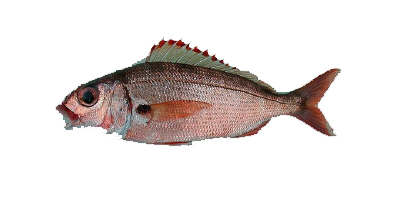
AXILLARY PANDORA : PAGELLUS ACARNE
Also called Besugo, Bokha, Boubrahim, small pandora or white pandora, it is a species that measures between 10 and 25 cm and a maximum of 36 cm, it has a gray-beige color with pinkish glints and its flanks are light silvery gray.
Its belly is white, its anal fin contains 9 or 10 rays, it stands out by the presence of a red-blackish spot at the level of the interior part of the pectoral fin and a very bright lateral line.
It is a demersal species that lives in multiple bottoms, especially the muddy ones as well as seagrass with posidonia. It lives in depths of 500 m but is more commonly found between 40 and 180 m.
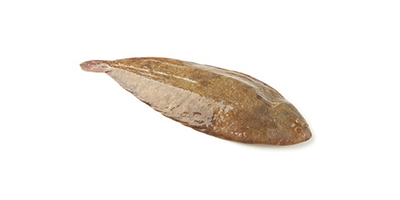
COMMON SOLEA : SOLEA VULGARIS VULGARIS
Also called Lenguado, Hout moussa. It is a species of the Soleidae family. it has a flat, elongated and oval body, its eyes are on one side : which is the brown side with dark spots and bright dots spread all over its body. The blind face is whitish.
The dorsal and anal fins run through the entire body and are bonded to the caudal fin by a membrane.
This species stands out by a very dark pectoral fin on the right side spotted with black and a rounded caudal fin streaked with a dark band.
Its common length is between 15 and 45 cm, its maximum length is 70 cm. It is a benthic species that lives in sandy and muddy bottoms. It lives in coastal waters, up to more than 200 m deep where its color makes it difficult to detect.
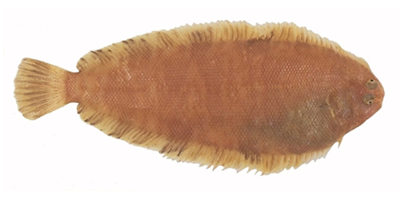
THICKBACK SOLE : MICROCHIRUS VARIEGATUS
Also called Hout Moussa, the thickback sole has an orange tint and dark stripes, it stands out by the size of the pectoral fin on the blind side which is less developed than the side that contains the eyes.
Its common length is 12 to 15 cm.
It is a benthic species that lives in muddy or sandy bottoms, as well as in seagrass and in the continental slope, it is commonly found between 80 and 100 m deep.
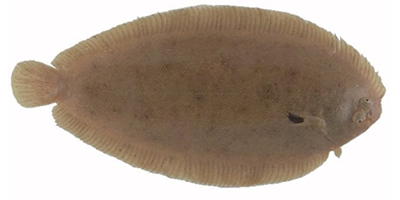
SAND SOLE : PEGUSA LASCARIS
Also called Hout Moussa, Lenguado, Naela; The sand sole is a species of flatfish that belongs to the Soleidae family.
Its common length is about 30 cm, the maximum length is 40 cm.
The main characteristic of the Pegusa genre is located under its whitish nadiral face; where the anterior nostril is enlarged by a series of fringes and resembles a rosette. The brown colored zenithal face is covered with small dark spots and bright punctuations.
It is a benthic species that lives in sandy and muddy bottoms in the continental slope, it is more commonly found between 10 and 50 m of depth.
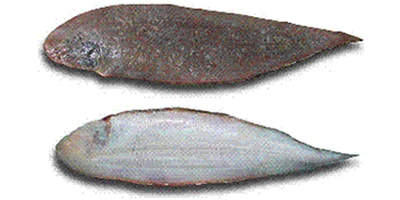
CANARY TONGUESOLE : CYNOGLOSSUS CANARIENSIS
Also called Langue (Tongue) or Sandiya, this species has a common length of 40 cm and a maximum length of 60 cm. It stands out by the presence of three lateral lines.
It is a benthic species that lives in sandy and muddy bottoms between 15m and 300 m of depth.
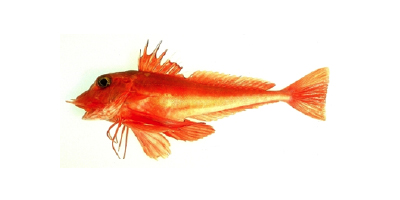
PIPER GURNARD : TRIGLA LYRA
Also called Robiot, Grondin or Aghounja, it has an elongated body and is covered with rough scales.
It stands out by its large head that holds two excrescences that looks like a lyre, as well as thorny excrescences that are behind its ears.
The body is orange-red with a light belly. Its length is between 10 and 40 cm and can reach up to 60 cm.
It is a benthic species that lives in muddy or detrital bottoms in the continental slope that can go down as deep as 700 m, but it is more commonly found between 150 and 400 m.
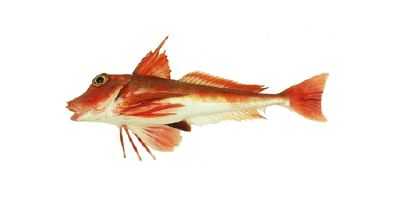
RED GURNARD : ASPITRIGLA CUCULUS
Also called Robiot, Grondin, It stands out by its scales in the the lateral line that are very high, the pectorals are shorter compared to the other Gurnards and start with three rays.
The body and fins are of a strong red, sometimes orange. The belly and the anal fin are light.
It measures between 10 and 25 cm with a maximum length of 50 cm.
It is a benthic species that lives in varied bottoms, it is commonly found between 50 and 180 m of depth, it gets closer to the coast in summer.
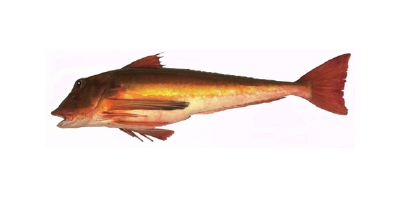
TUB GURNARD : CHELIDONICHTHYS LUCERNA
Also called Trigle hirondelle (Swallow) or Robiot. This species has a laterally compressed elongated body. Its common length is between 20 and 40 cm with a maximum length of 70 cm.
Its armored head has strong opercular spines as well as other smaller ones on the hypertrophied orbital arch. The lateral line is covered with simple single scales with the absence of axillary scales.
It is a benthic species that lives in sandy, muddy or gravely bottoms in the continental slope up to 300 m deep.
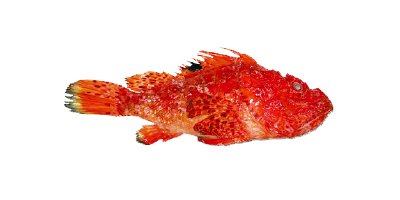
RED SCORPIONFISH : SCORPAENA SCROFA
Also called Chapon, like all the other scorpionfish, it has a bulky body, a massive head, it’s covered with many skin layers, it has large eyes, its mouth is very wide and its tail has three dark bands.
This species stands out by the presence of cutaneous flaps under its lower jaw and a black spot on its dorsal fin.
Its back and flanks are orange-red covered by large bars of different shades that provide an excellent camouflage.
The red scorpion fish can reach up to 66 cm, its common length is between 20 and 30 cm. It is a benthic species that lives in rocky or muddy bottoms in the continental slope and Posidonia seagrass. It lives from the surface to 370 m of depth but is more abundant between 20 and 100 m.
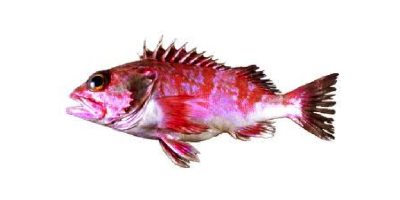
BLACKBELLY ROSEFISH : HELICOLENUS DACTYLOPTERUS
It is also called Agrab or Sébasté chévre (Goat), it has identical characteristics to other scorpion fish. The skin flaps on the other hand are absent around the jaw and are very rare on the rest of the body.
It stands out with its relatively large eye that has a ring of pale yellow around of it.
It is bright red, its pectoral fin has 8 to 9 rays on the third of its length, and the second dorsal fin has 11 soft rays or more (the last one is a double ray).
Its common length is between 15 and 25 cm for a maximum length of 45 cm.
It is a demersal species of the continental slope. It lives in depths of 20 to 1000 m but is more commonly found between 100 and 300 m.
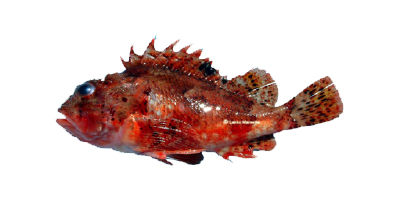
SMALL RED SCORPIONFISH : SCORPAENA NOTATA
This species has identical characteristics to those of other scorpion fish.
There are no skin flaps around the lower jaw, very short ones on the orbital arches, but it’s present on the rest of the body. The snout is quite short and the operculi bear thorns.
It is red-orange marbled with brown bars, there are small light spots on the flanks.
It has a common length of 10 to 15 cm, and a maximum length of 24 cm.
It is a benthic species that lives in hard bottoms (sandy, rocky, gravely and seagrass) from 15 to 700 m deep, but is more present at 300 m.
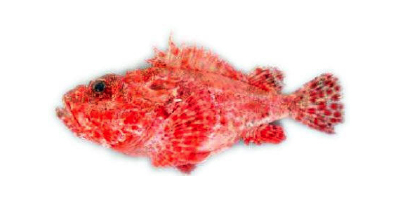
SLENDER ROCKFISH : SCORPAENA ELONGATA
Its body is less bulky than the other scorpion fish. There are no skin flaps under the lower jaw, there is a fairly developed characteristic flap at each corner of the mouth.
The back and flanks are reddish, between pink and orange, sometimes yellowish. The whole of its body is covered with some dark bars as well as some white ones.
It has a common length of 20 to 40 cm and a maximum length of 60 cm.
It is a benthic species that lives in rocky or muddy bottoms, from 75 to 800 m deep.
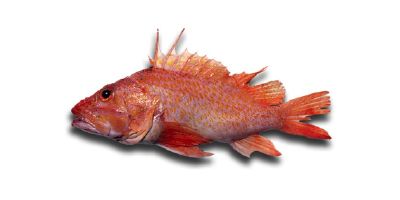
SCORPION FISH : PONITUS KUHLII
This benthic species stands out by its pectoral fins that do not reach the start of the anal fins, it has a maximum length of about 52 cm and a common length up to 31 cm.
It lives on hard bottoms on the edge of the continental slope, between 100 and 450 m deep.
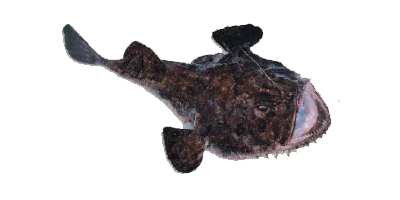
ANGLER : LOPHIUS PISCATORIUS
Also called Lotte. It has a very flattened body in the dorso-ventral direction. Its large head takes nearly half of its body, its skin is completely smooth and has no scales.
Its back is yellowish-brown or green with dark mottling, its flanks are light and its belly is white. The angler has an almost perfect mimicry.
Its common length is between 20 and 100 cm and its maximum length is 200 cm.
It is a benthic species that lives in coastal waters in at least 500 m of depth, sometimes as deep as 1000 m.
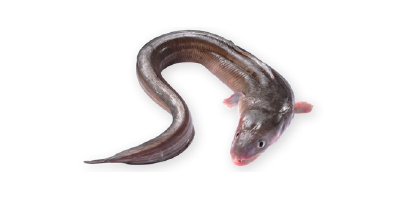
EUROPEAN CONGER : CONGER CONGER
Also called Farkh, Sennour or Ghrang, it is an anguilliform fish that belongs to the Congridians family.
With a very long oval and almost round body, its skin is covered with a thick mucus, its head is slightly flattened and the start of its dorsal fin is slightly before the end of the pectoral fins.
Its color changes depending on the nature of the habitat. The back and the high flanks vary from gray to dark brown, sometimes almost black. The lower flanks and belly are light.
It is a benthic species that lives in rocky and sandy bottoms of the continental slope, from the surface to 500 m of depth.
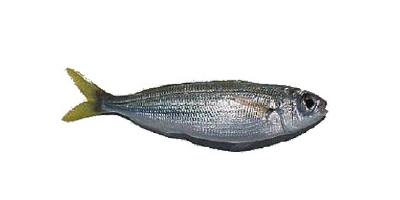
BOGUE : BOOPS BOOPS
Also called Boga or Targhzalt. It is a species of the Sparidae family, it has a fusiform and an elongated body, it has a common length of 10 to 25 cm and a maximum length of 36 cm.
Its body is silver with 3 to 5 golden horizontal lines and a brown bar above the pectoral fin, its eyes are relatively large.
It is a demersal and epipelagic species of the continental slope and moves in groups in multiple bottoms(sandy, muddy, rocky and seagrass) up to 350 m deep.
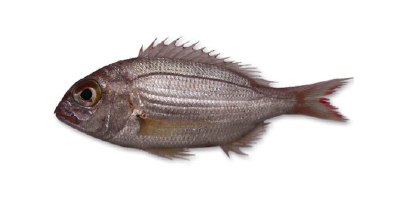
MOROCCAN DENTEX : DENTEX MAROCCANUS
Also called Sama, Voracé or Katchouchou. It is a species of the sparidae family with an oval and compressed body, it’s reddish on the back and lighter on the flanks with silvery glints.
This species stands out by its red caudal fork as well as the absence of the molar tooth with only caniniform teeth.
Its common length is between 15 and 25 cm and can reach up to 45 cm.
It is a demersal species that lives in varied bottoms. it lives from 20 to 250 m deep.
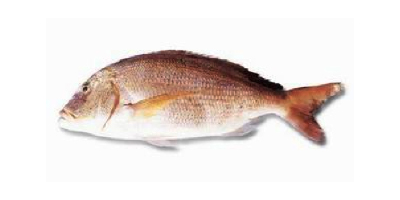
COMMON DENTEX : DENTEX DENTEX
Also called Sabia or Denti. It has a fairly high and compressed, ovoid shaped body, greyish to bluish gray with black spots on the dorsal half. The forehead is slighted rounded for the adults and flat for the young ones.
This fish owes its name to its canine teeth, which give it an aggressive look.
Its common length is between 20 and 50 cm and a maximum length of 100 cm. It is a demersal species that lives in hard bottoms (rocks or conglomerates) of the continental slope for as deep as 200 m, but is more commonly found between 15 and 50 m.
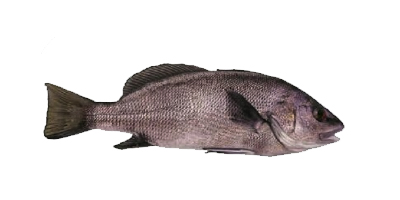
BROWN MEAGRE : SCIAENA UMBRA
A laterally compressed and a relatively high body. It stands out by the absence of a chin barbel, by its black pelvic and anal fins and by the lower part of the caudal fin which is bordered with black.
Its common length is between 20 and 35 cm with a maximum length of 70 cm.
The brown meagre lives in deep coastal waters, from 20 to 180 m, especially in rocky and sandy bottoms. It often enters estuaries. It is more active at night.

MEAGRE: ARGYROSOMUS REGIUS
A large elongated and silver-colored fish with bronze glints, it has a large head with small eyes, the snout is rounded and protrudes beyond the lower jaw.
The lateral line forms large silvery dotted lines, clearly visible from the top of the operculum to the caudal. The second dorsal fin is longer than the first.
Its common length is between 30 and 100 cm with a maximum length of 200 cm.
It is a species that lives on the continental slope both near the bottom and the surface as well as in midwater. It lives from 15 to 200 m of depth and it enters estuaries and coastal lagoons.
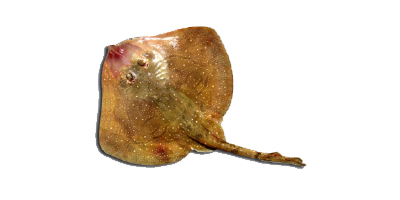
UNDULATE RAY : RAJA UNDULATA
Locally named Raya, it has an obtrullate body with slightly sinuous front borders and rather round wing tips. Its snout is short and obtuse. At the end of its body is a long, slender, pointed tail that has two dorsal fins at its tip and a short caudal fin.
Its skin is rough due to cutaneous denticles and a row of spines located on the dorsal median up to the dorsal fins.
This species is brown to greenish and stands out by the presence of dark lines bordered by small white dots as well as with the presence of two close light ocelli circled in white.
The ventral side is white and the end of the tail is gray-brown.
Its common length is between 40cm and 60cm with a maximum length of 100cm.
It is a benthic species that lives on the surface for as deep as 300m in soft and sandy bottoms.
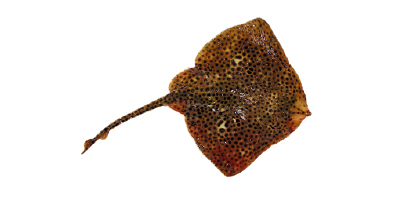
BLONDE RAY : RAJA BRACHYURA
It is ocher-brown with a regular median row of less than 50 visibile and permanent ringlets, from its neck to the first dorsal. It stands out by the presence of many small dark spots up to the edge of the discs which sometimes encircle light spots that build a ring but not an ocelle.
Its common length is between 40 and 80cm with a maximum of 125cm.
It is a benthic species that lives from the surface to 400m deep especially on sandy, hard and deep muddy bottoms.
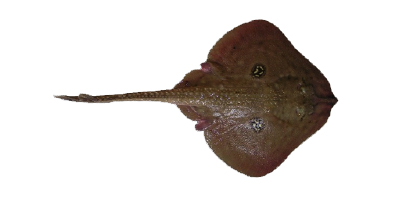
CUCKOO RAY : RAJA NAEVUS
Its common length is between 30 to 50 cm with a maximum of 70cm. it stands out by the presence of ocelliform spots on each of the pectoral fins that are distinctly black with irregular yellow spots and stripes, a large triangular range of ringlets on the neck, four parallel rows of curls on the tail and its medials extended on the disk.
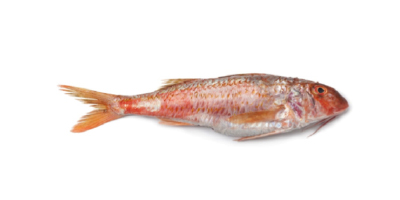
RED MULLET : MULLUS BARBATUS
Locally named Rouget. It is a fish with an elongated body, its head has a steep frontal part and is curved to the eyes, it carries two white chin barbels under the lower lip.
The color of the body is reddish-pink marbled sometimes with a red cross-band, the flanks have silvery glints and the belly is white.
It stands out by its colorless first fin, the other fins are very slightly tinged with red and yellow.
Its common length is between 10 and 20 cm with a maximum length of 30cm.
It is a demersal and benthic species that lives on sandy, muddy and gravely bottoms from the continental slope, from 5 m to almost 500 m deep.

STRIPED RED MULLET : MULLUS SURMULETUS
Also called Rouget, Salmonete, Soltan al Hout, Boulahya or El cadi. Its body is elongated and laterally compressed, its head has a little convex snout and its mouth has two chin barbels.
The operculaes are striped, reddish in color with yellow and red horizontal bands on the flanks. The first dorsal fin is covered by two brown bands
The common length of this fish is between 10 and 25 cm with a maximum of 40 cm.
It is a demersal and benthic species that lives in bottoms of rocks and gravel, sometimes also soft bottoms as deep as 400 m at least.
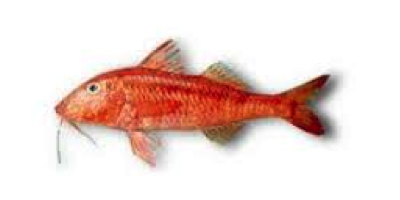
WEST AFRICAN GOATFISH : PSEUDUPENEUS PRAYENSIS
This species has a pink-red livery striped with three to four fine red longitudinal lines, it s different from the other red mullets by the presence of a spine on the posterior edge of the operculum.
Its common length can be up to 25 cm and a maximum of 55 cm.
It is a demersal and coastal benthic species that enters estuaries and lagoons between 10 and 300 m deep.
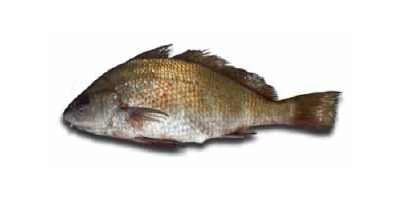
CANARY DRUM : UMBRINA CANARIENSIS
Locally named Maaza, Chevrette or Courbina. It is a fish with a high, laterally compressed body. Its head is relatively small with a rounded snout and a small inferior mouth with a chin barbel.
The color of its body and fins is silvery gray with greenish glints. the opercular membrane is dark brown and several oblique lines are visible on the flanks
Its common length is between 25 and 35 cm with a maximum length of 63 cm.
It’s a species that lives in sandy and deep bottoms of the continental slope between 5 and 300 m of depth. It is more common between 160 and 180m deep.
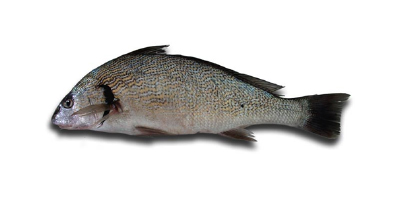
SHI DRUM: UMBRINA CIRROSA
Locally named Maazaou or Corvina, it has a laterally compressed and elongated body, it has the same characteristics as the canary drum but it stands out by its very black opercular membrane and the color of its body which is silvery gray with oblique stria on the golden yellow flanks that have dark borders. The fins have a whitish color.
Its common length is between 30 and 80 cm with a maximum of 100 cm.
This species lives in coastal waters, from the shore to 100 m of depth in rocky, sandy or gravelly bottoms.
The young ones often enter estuaries.
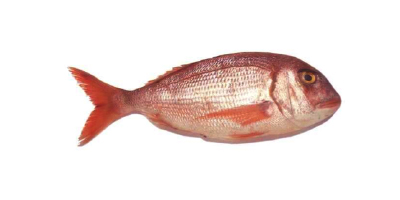
RED PORGY : PAGRUS PAGRUS
Locally named Amzough or Paghar. It is a fish of the sparidae family with a fairly high and a laterally compressed body with a bulky head. It is silver with pink glints and sometimes blue punctuations on the flanks especially in the young ones.
It stands out by the presence of a single red bar in the interior part of the pectoral fins as well as by its thorny fins, The first radius of its pelvic is is soft filamentous.
Its common length is between 20 and 60 cm with a maximum of 82 cm.
It is a demersal species that lives in hard or sandy bottoms for as deep as 250 m, it is more abudant at 100 m.
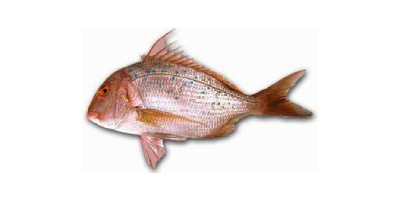
BLUEPOINTED PORGY : PAGRUS CAERULEOSTICTUS
Locally named Chama or Zouagh. It has a pink laterally compressed body, its back is spotted with many bright blue dots and no transverse bands.
The first two spines of the dorsal fin are very short, the third, fourth and fifth anterior spines are tapered and much longer than the ones that come after.
Its common length is between 20 and 50 cm with a maximum of 90 cm.
This demersal species lives in hard bottoms up to 200 m deep, it is more abundant between 50 and 100 m. the adults live offshore while young ones live near the coast.
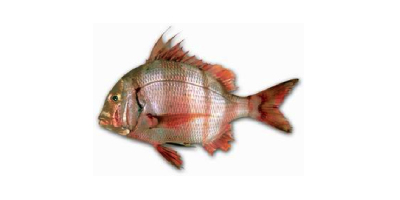
MURUDAI : PAGRUS AURIGA
Locally named Berdad, Zougah or Cocher. It stands out by its pink back with 4 to 5 dark reddish brown bars, the edge of the operculum is very dark.
Its dorsal fin has its first two spines short, the third, fourth and fifth anterior spines are particularly extended in its youth.
Its common length is between 20 and 30 cm with a maximum of 80 cm. it is a demersal coastal species that lives in hard bottoms up to 170 m deep.

SAND STEENBRAS : LITHOGNATHUS MORMYRUS
Also called Hambal, Bermelo, Takba or Rmouli, it is a species of the Sparidae family, it has an elongated body with a silvery color and sometimes with yellowish glints, it stands out by its relatively elongated snout and the presence of 14 to 15 green-brownish bars in the mid-flanks.
Its spiny dorsal fin extends to the caudal peduncle which is bordered with black, its ventral and anal ones are yellowish.
Its common length is between 15 and 30 cm with a maximum of 55 cm.
This coastal demersal species lives in sandy or sandy-muddy bottoms, it also lives in seagrass for as deep as 150 m.

EUROPEAN BASS : DICENTRARCHUS LABRAX
Also called Common Bass, the Wolf, Darii, Lahrach or Bouchouk. It is a species of the moronidae family.
It has an elongated, slightly compressed body which is silver-colored on the sides and silver-gray to bluish on the back.
It stands out by two distinct dorsal fins, the first of which is endowed with thorny rays, as well as by its indented caudal fin and its head that is covered on the top and on the side by cycloid scales.
Its common length is between 20 and 55 cm with a maximum of 100 cm.
It is a fish that lives in coastal waters up to about 200 m deep, it often enters estuaries and sometimes move up the rivers.
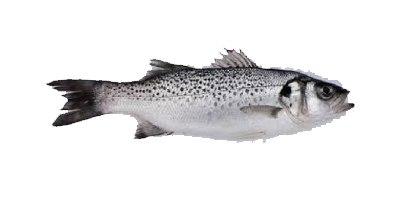
SPOTTED SEABASS : DICENTRARCHUS PUNCTATUS
Locally named Bounakta, Darii, loup bar (Wolf bass) or Nobira. It is very similar to the common bass but it stands out by its two dorsal fins having the same length and the same height, it also has a bluish gray back with several black spots and a very light black spot on the operculum.
its eyes are larger than the European bass.
Its common length is between 20 and 40 cm with a maximum of 70 cm.
It lives in coastal and brackish water, in sandy or rocky bottoms and occasionally goes into fresh water.
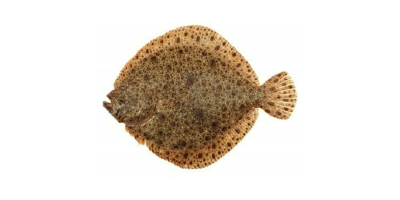
TURBOT : PSETTA MAXIMA MAXIMA
Locally named Lkaraa, Kobaa or Rodaballo, it is a flatfish that is shaped like a diamond, its head and zenithal surface are covered with characteristic bony tubercles. Its eyes are on its left side and the space between the eyes is larger than the size of an eye.
Its lateral line is located above the pectoral, the first radiuses of the dorsal fin are free and it is in front of its upper eye.
The coloring of the body is quite variable given the mimicry capacity of the turbot, its nadiral face is whitish without any pigmentation.
Its common length is between 40 and 50 cm with a maximum of 100 cm.
It is a benthic species that lives in sandy and stony bottoms up to 100 m deep at least.
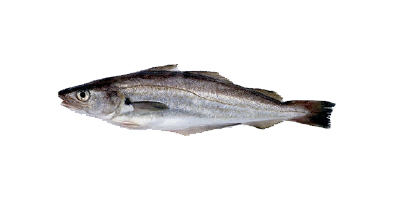
WHITING : MERLANGIUS MERLANGUS
The whiting has a slender body with three dorsal fins, two adjacent anal fins, and a straight caudal fin practically without notch. It stands out by a small dark spot at the upper base of the pectorals.
The back of the whiting is light blue-green, the flanks are green-yellow and the belly is white with silver glints in the fish when alive.
Its length is often 30 to 40 cm with a maximum of 70 cm.
It is a demersal fish that frequents cold waters. It lives most often in coastal waters with gravely or muddy bottoms but also in sandy or rocky bottoms.
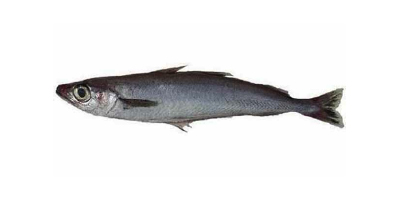
BLUE WHITING : MICROMESISTIUS POUTASSOU
Blue whiting can often be confused with the normal whiting, it stands out by its spaced dorsal fins, the absence of black spot at the base of the pectoral and a prominent lower jaw.
Its maximum length is estimated at about 50 cm.
It is a gregarious benthopelagic fish that lives in deep water and at a greater depth than the normal whiting, which is between 300 and 400 m depth.