






Seashells are molluscs, their body is covered by a shell that can have two different shapes:
• A shell jointed on two valves: the bivalve molluscs or lamellibranches for example.
• A unique shell: It can be spiral, flat or conical ; the gastropods for example.
Among the species that belong to the bivalves family are the mussels, oysters, shells, clams... they all feed on phytoplankton or organic matter. The gastropods is characterized by the fact that their body stands on one foot, by a well developed head as well as a protective univalve shell, the species that are most commonly found in Morocco are the periwinkles, the abalone... etc. Seashells production comes by harvesting from natural accumulations on foot, by diving, by dredging or by bottom trawling depending on the living area of the species or on the seashells farming, the oyster farming or the mussel farming.
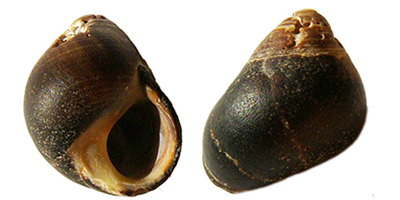
Periwinkle : LITTORINA LITTOREA
Also called the common periwinkle or the true periwinkle, it has a rolled up shell and is part of the gastropods group.
The periwinkle stands out by its height that can reach up 3 cm, by its very dark color brown to black and by its shell with fine stripes softening with age.
The periwinkle is a very common seashell that can be found everywhere along rocky shores in the northern Atlantic Ocean.
It lives in the lower layer of the seashore and sometimes in the salt marshes.
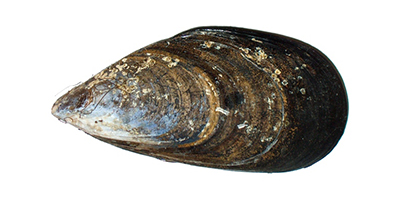
Mediterranean mussel : MYTHILUS GALLOPROVINCIALIS
Mytillus galloprovincialis is a species specific to the Mediterranean sea with a blue-black shell. It is sedentary, it lives on multiple bottoms, either hard (rocky, gravelly) or soft (sandy, muddy). It enters widely the brackish waters of the coastal lagoons. This bivalve has a rapid growth depending on the conditions of the living area that can go up to a maximum length of 15 cm, its common length is between 5 and 8 cm. A mussel can filter through its gills up to 10 liters of water per day.

Pacific oyster : CRASSOSTREA GIGAS
Also called the japanese oyster, it comes from the northwestern Pacific and was introduced to Morocco for commercial breeding. Crassostrea gigas is a bivalve mollusk of brownish-gray color with sometimes purple spots. The inside of the shell is gray-white. It measures up to 15 cm long. The shell is elongated, oval and rough. It has many crenellated concentric ridges that give the borders a serrated appearance. The lower valve is very hollow, the upper one is slightly curved. The seawater is filtred by the oysters to extract the microscopic algae it feeds on.
It lives affixed to the rocks or on soft bottoms from the surface up to 80 m of depth.
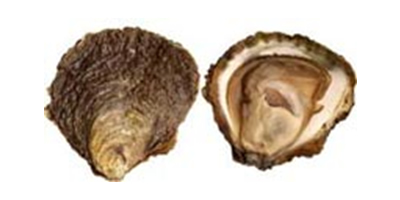
European flat oyster : OSTREA EDULIS
It is a bivalve mollusc that measures up to 10 cm in diameter. The flat oyster’s shell is irregular, round, and thick with a hollow lower valve and a flat upper valve, it has a laminated and a chalky structure.
It has a gray to yellow color with sometimes dark spots or stripes. The interior is greyish white, pearly and smooth.
The shells are affixed to the rocks or to each other by the lower valve (or left valve). Their outline is often crenellated.
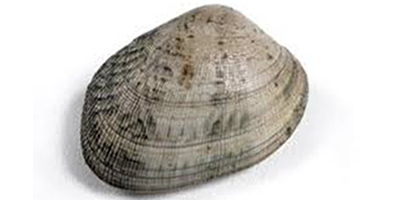
Grooved carpet shell : RUDITAPES DECUSSATUS
It has a very oval/square shell, thin concentric carved stripes and clearly visible radial lines. Its common length is between 4 and 5 cm with a maximum of 8 cm.
The grooved carpet shell lives in the sand and the mud, it is found in the sand betwen 15 and 20 cm of depth from the middle of the intertidal zone to a few meters deep. Its genders are separate, although hermaphrodites can sometimes be found.
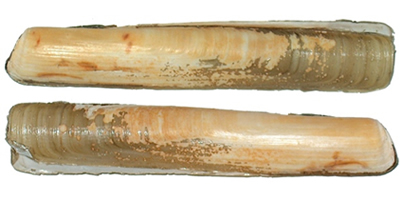
Grooved razor shell : SOLEN MARGINATUS
Also known as "couteau-gaine" (knife-sheath). Its name refers to the fact that it has a perfectly rectilinear shape.It is a long and narrow bivalve and is found along the Atlantic coast. Its average length varies from 12 to 15 cm long. The shells are smooth and connected to each other. The atrophied head is at one end of the shell and on the other end is an ax-shaped foot.
The knife-sheath lives in areas between the highest and lowest tides of the coarse sand. It is easily seen when there is a low tide by the presence of small holes having the number eight’s form.
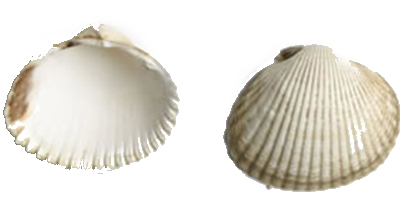
Common cockle : CERASTODERMA EDULE
Also called white cockle, it is an endogenous and an ubiquitous bivalve that can live in multiple biotopes. Its two symmetrical valves form a round and curved collection. Its external color varies between white, beige and ocher.
Individuals live on average 2 to 4 years, but can reach up to 10 years. It is a gonochoric species, its sexual maturity is more dependent on its size than its age, it’s about 13 to 16 mm. Its maximum length can reach up to 5.3 cm.
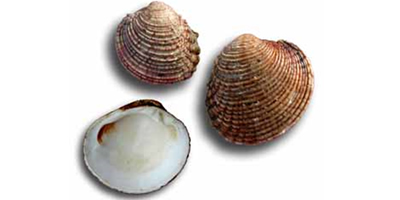
Warty venus : VENUS VERRUCOSA
It is a bivalve mollusc that lives in sandy/muddy coastal bottoms, it has a thick rounded shell that is decorated with very concentric stripes. Its color varies from yellowish-white to greyish-white.
These areas of regular growth end with verrucous tubercles mainly visibile on the posterior sides.
Its average length is 4.5 cm but it varies from 3 to 7 cm and its thickness can reach 3 cm.
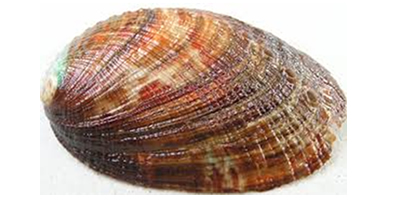
Ormgreen er : HALIOTIS TUBERCULATA TUBERCULATA
It is a large gastropod that has a flat thick and oval shell that measures 8 to 11 cm long. The shell is reddish brown sometimes marbled with cream. It is often covered with encrusting organisms especially in the older individuals. Its brown-green mantle is surrounded by numerous sensory tentacles that come out of the perforations of the shell. The interior head bears two visible blue eyes. Its foot is large which allows a very powerful adhesion to the substrate.
The ormer lives on rocks where it feeds on red algae. It is found from the surface up to 15 m deep.
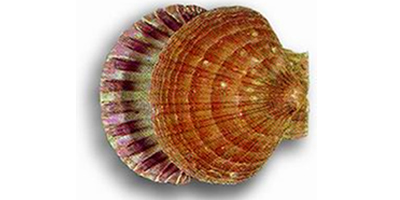
Great scallop : PECTEN MAXIMUS
It is a bivalve mollusc of the Pectinidae family. This is the most desired species from the gourmets. It stands out by its large length compared to other species of the Pecten family as well as by its fan-shaped ribs on its shell. The upper valve is completely flat. The rounded ribs are approximately between 15 and 17.
Its color is red to brown, sometimes pink or mottled, its maximum length is 16 cm for an age of 7 years.

Wedge clam : DONAX TRUNCULUS TUBERCULATA
It is a small filtering bivalve mollusk that lives buried in the sand for about 2 to 3 cm.
Its shell is solid triangular and is light yellow to dark yellow with streaked dark lines. Its two symmetrical valves of triangular shape are connected by an external ligament.
This shell has two short siphons that allow it to filter the water.