






A "pelagic" is type of a fish that lives in waters near the surface or between the surface and the bottom. Small pelagic species include sardines, horse mackerel, anchovies, sardinella, etc... Tuna and swordfish figure among the large pelagic species.
Among the fishing places and techniques for this group of fish are beach seines and purse seines, pelagic trawls and gill nets, hand lines and troll lines, long lines, lamparos nets and semi-pelagic trawls.
The small pelagics
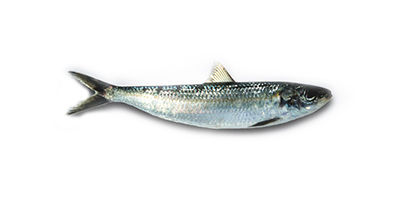
COMMON SARDINE : SARDINA PILCHARDUS
The sardine is part of the Clupeidae family, it possesses a fused body, a silver back and a white belly. It has a common length of 15 to 20 cm and a maximum of 25 cm.
It is characterized by the presence of radiating bone striations on the operculum and dark spots on the back. Its scales are sessile and the last two rays of its fish bones are longer.
Sardine is a gregarious fish that gathers near the coast. It lives up to 200 m deep but is more commonly present between 25 and 55 m during the day and 15 to 35 m during the night.
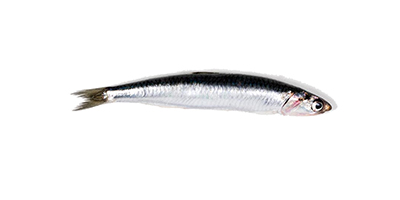
COMMON ANCHOVY : ENGRAULIS ENCRASICOLUS
Locally named Lanchouba, the anchovy has a slim and elongated body. Its back is bluish green, its flank and belly are silver with a blue gray stripe that extends between the back and the flanks.
It is characterized by the absence of the lateral line and the scutes. His inferior mouth is very long.
Its common length is between 7 and 15 cm, up to 20cm maximum.
This coastal pelagic species goes as deep as 100 and 180 m in winter. Sometimes it gets caught at 400m of depth.
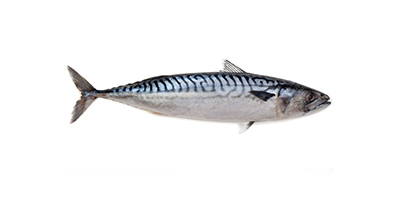
COMMON MACKEREL: SCOMBER SCOMBRUS
Locally named Kabaila or Zaroug, this species is characterized by a body of blue stripes and a clear white belly. The caudal peduncle is laterally carinated and has 5 dorsal and 5 anal finlets.
This species is 18-30 cm in length, is gregarious and it forms groups of the same length. It is epipelagic or meso-demersal. It lives on the surface up to 250 m deep in normal time, in deep waters in winter and near the coast in spring..

SPANISH MACKEREL : SCOMBER JAPONICUS
It is very similar to the mackerel (Scombrus scombrus) but is characterized by dark spots around the inferior part.
The back is greenish blue with pale wavy lines. The flanks and belly are silvery yellow.
The maximum length is about is 50cm, commonly between 15 to 30 cm.
This fish forms groups of individuals of the same length and makes long seasonal migrations. It is epipelagic from the surface to 300 m depth.
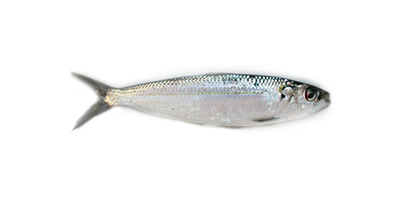
ROUND SARDINELLA: SARDINELLA AURITA
Also called Allache or Latcha, blue to bluish green of color, it has silver sides and a white belly. It differs from the sardine by the presence of black spots on the smooth operculum with no stripes but also the absence of spots in the rest of the body.
Between 15 and 25 cm of common length that can reach up to 38 cm. This coastal pelagic species is commonly found near the surface in the nearshore waters and can go as deep as 350 m.
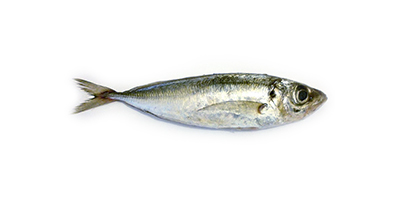
HORSE MACKEREL: TRACHURUS TRACHURUS
Locally named Chernne, it has a fusiform body and is laterally compressed, it is gray in color but the rest of the body is pearly white. This small pelagic has a common length of 15 to 30 cm and can go up to 60 cm.
This species is characterized by the accessory lateral line that ends at the beginning of the peduncle, it also has black spots at the tip of the operculum, above the pectoral and in the gray caudal fin.
It is a gregarious species, frequently found on the sandy bottom, at a depth of about 100 to 200 m and sometimes as deep as to 600 m.
The large pelagics
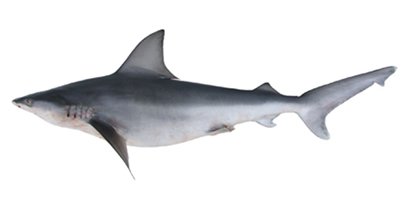
GRAY SHARK: CARCHARHINUS PLUMBEUS
Massive body, chunky back, completely gray with a white belly. It is characterized by a short snout with a curved mouth in line with small eyes as well as by its first dorsal fin, which is very high compared to others of triangular shape and starting from the axis of the pectoral ones.
The pectoral fins are imposing, long and sharp and the caudal fin is asymmetrical.
Its common length is about 220 cm and can go up to 239 cm.
It is a coastal and oceanic pelagic species that lives on the surface as deep as 280 m on sandy or muddy bottoms often located near estuaries.
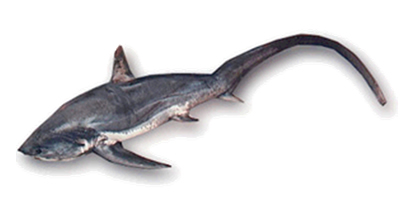
THRESHER: ALOPIAS VULPINUS
It is a large shark characterized by a very asymmetrical caudal fin and a very elongated upper lobe with a length almost equal to that of the body. The conical snout is relatively short, the eyes are small and do not have furrows on the head.
Its common length can reach up to 490 cm with a maximum of 609 cm.
It is a pelagic species that lives in coastal and offshore waters as deep as 400m.
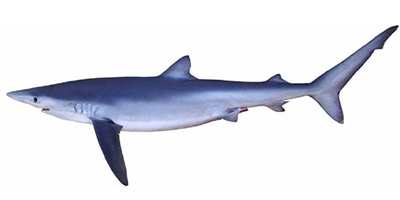
BLUE SHARK : PRIONACE GLAUCA
Also called sea dog, or Kalb labhar. This shark has a very slim body of cobalt blue to electric blue color, its belly though is white. On the edge of its head is a long conical and pointed snout along large eyes provided with a nictitating membrane. It is characterized by the absence of the intradermal ridge, a weak keel on the caudal peduncle as well as very long pectoral fins.
Its caudal fin has a very elongated upper lobe and small dorsal fins.
The common length of this shark is between 150 cm and 300 cm but it can go up to 400 cm.
This species is oceanic pelagic, it usually can be found offshore but also in coastal waters between the surface and about 152m depth.
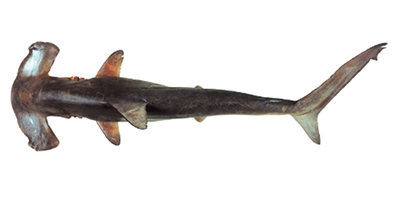
COMMON SMOOTH HAMMERHEAD : SPHYRNA ZYGAENA
Locally named Jadarmi or Karnoda. This shark has an elongated and moderately slim body, its back is grey/copper colored and his belly is white. It is characterized by a dorsoventrally flattened anterior head part and is extended laterally by two expansions bearing the eyes on their lateral edge with well-developed lower nictitantes membranes.
This species stands out from the other hammerhead sharks by the absence of notches in the center of the head. Its maximum length is at least 400cm.
It is a semi-oceanic pelagic species, it is usually found in coastal waters and lives on the surface of water, at least 20 m deep.
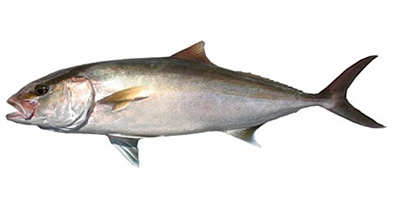
GREATER AMBERJACK : SERIOLA DUMERILI
Compressed laterally, the amberjack is an elongated oval fish. It stands out by its massive head characterized by a dark band that covers the eye, it starts from the mouth and goes up to the operculum. The caudal fin is notched and the caudal peduncle is relatively thin.
Its color can be variable, the flanks are silvery and the back varies from silvery blue to gray-green. The fins are often stained with yellow.
Its common length is between 30 and 50 cm, it can go up to a maximum of 190 cm.
It is a species that is both epibenthic and pelagic. It usually lives between 20 and 70 m on reefs, marine trenches and on the continental slope.
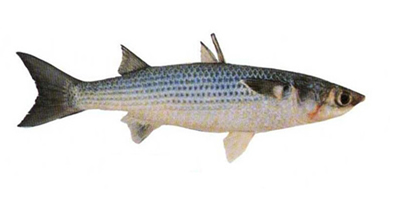
FLATHEAD GREY MULLET: MUGIL CEPHALUS
Locally named Bouri, it is a species of the mugilidae family. Its back is olive grey, its flanks are silvery with golden and blue glints and its belly is white.
Its head is covered with scales all the way down to its rounded snout, it is characterized by vertical mushy, oval slit eyelids and its very thin upper lip.
Its maximum length can reach up to 120 cm.
It is a coastal pelagic species that swims even through lagoons and estuaries.
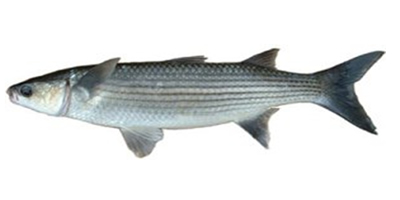
THICKLIP GREY MULLET: CHELON LABROSUS
This species stands out of all the other species by its white, thick upper lip on the tip of the snout. This lip carries up to 5 rows of buds on the lower edge.
Its back is dark with blue or green glints, streaked with darker longitudinal lines and is covered with large smooth scales, its belly is bright white,
Its maximum length is about 60 cm.
This coastal pelagic lives in shallow water and swims through brackish lagoons.
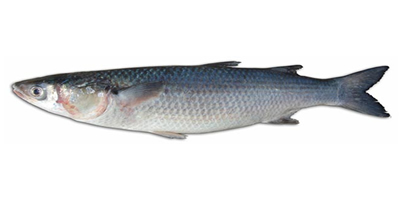
THINLIP MULLET: LIZA RAMADA
Also called muge capitan or Bouri. Its body morphology is similar to that of other species of mullet. It is stands out through its sharpened head, its lips are less thick and there is a black spot in the armpit of the pectoral.
Its maximum length is about 70 cm.
This coastal pelagic species swims through lagoons, estuaries and freshwaters.
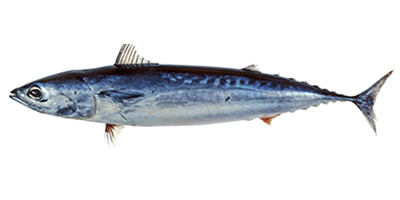
BULLET TUNA : AUXIS ROCHEI
Also called Bonitou or Melva. It is a fish with a fusiform body. Its head is pointed with small eyes. Its back is dark blue, dark transverse bars are on the upper side of its flanks, its belly and its flanks are pearly white.
Its dorsal fin has between 10 and 11 spines and its pectoral fin is small and does not reach the area that is scaleless.
Its common length is between 20 and 40cm and its maximum is 50cm.
It is an epipelagic species, both oceanic and neritic. The adult form is mainly caught in coastal waters and near islands.
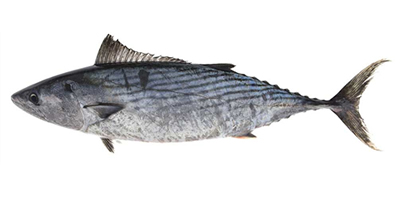
ATLANTIC BONITO : SARDA SARDA
Also called Bonitou, Sarda or Bacora. It has a fusiform body and is laterally compressed with a pointed head along small eyes. The back is dark blue with 7 to 11 oblique dark lines, the belly and flanks are white pearly.
The two dorsal fins are slightly separated, the first of which has a rectilinear profile with 20 to 23 spines.
Its common length is between 25 to 65cm and its maximum length is 90cm.
It is a migratory epipelagic species that forms groups near the surface, it mainly lives in coastal waters up to 200m deep.
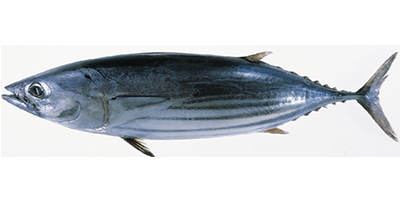
SKIPJACK TUNA: KATSUWONUS PELAMIS
Also called Listao, it stands out by five to six dark longitudinal bands on the lower part of its flanks. The back is blue, the flanks and the belly are silver with a metallic glint.
Its common length is between 30 to 60 cm and its maximum length is 108 cm.
This pelagic species forms large groups in deep coastal and oceanic waters, usually above the thermocline.
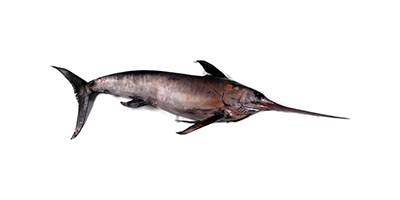
SWORDFISH: XIFIAS GLADIUS
Locally named Spada or Bousif. A large pelagic, highly migratory, characterized by a long, flat bill. Its smooth skin is blue steel on the back and silver on the belly.
In adulthood, it can weigh several hundred kilograms and measures over 450 cm, its common length is between 80 cm and 350 cm.
The swordfish is an oceanic mesopelagic species that lives starting from the surface to 800 m of depth. Usually alone, sometimes in small groups. It migrates between temperate and cold waters (nursery areas) as well as warm waters (spawning areas).
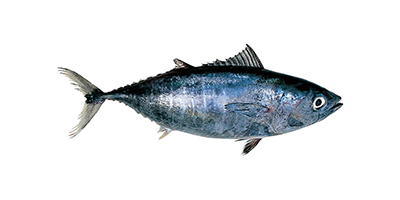
ATLANTIC BLUEFIN TUNA : THUMUS THYNNUS THYNNUS
Large pelagic fish characterized by the red color of its flesh. Its body is fusiform and thick, Its back is dark blue to black, its belly is silver with clear vertical lines and spots.
This species is characterized by its very short pectoral fin and the reddish-brown color of the dorsal finlets.
These are the largest species of tuna; It has a common length of 50 to 150 cm and a maximum length of more than 300cm. Its weight in adulthood is around 400 kg.
The atlantic bluefin tuna is a mesopelagic species. The young gregarious mix with other species of the same Scombrides family, the weaned immature of them stay in warm water, the adults on the other hand enter cold water for food.
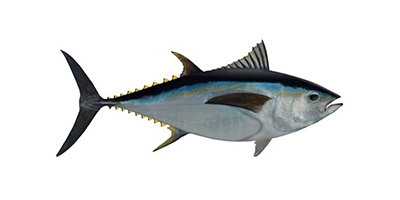
BIGEYE TUNA : THUMUS OBESUS
Its body is fusiform. Its back is dark metallic blue to dark yellow above a bluish line on the flanks, its belly is whitish gray.
It is very similar to the bluefin tuna but it stands out by its longer pectoral fin and the color of its dorsal and anal pinnules, which is bright yellow bordered with black.
It is a large pelagic fish with a maximum length of 239 cm, the common length is about 100cm.
The Bigeye tuna is an oceanic mesopelagic species that can be caught starting from the surface to 250 meters of depth. The Bigeye tuna are sociable and group together with other species of tuna as well as other fish to form mixed groups.
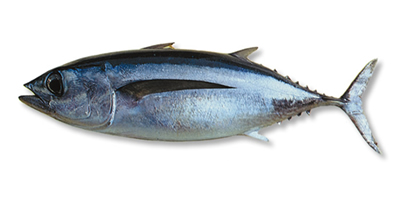
LONGFIN TUNA : THUNNUS ALALUNGA
Locally named Thon el hor or Bacora. Its back is dark gray blue, its flanks and belly are pearly and bluish. It stands out by the exceptional length of its pectoral fins, by its anal pinnules of dark color as well as by its caudal fin with white edge.
Unlike the bluefin tuna, its flesh is white. Its common length is between 50 and 80 cm and the maximum length is 130 cm.
It is an oceanic and mesopelagic species that can live as deep as 100m below the thermocline.
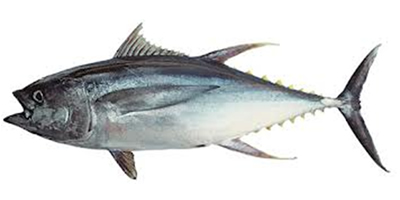
YELLOWFIN TUNA : THUNNUS ALBACARES
Its back is dark blue to black, its flanks are silvery and its fins are bright yellow. Specifically for the large individuals, the second dorsal fin and the anal fin are very long and are in the shape of a reaping hook.
Its common length can be up to 150 cm and the maximum length is 200 cm.
It is an oceanic and mesopelagic species that can live above and below the thermocline.
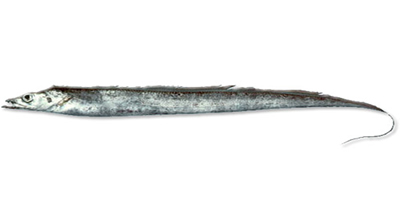
LARGEHEAD HAIRTAIL : TRICHIURUS LEPTURUS
Also called semeta, sif or belt. It is a fish that lives in deep waters with an extremely elongated and strongly compressed body, gradually slimming to fine-pointed tip. It is scaleless. Silver-gray in color, its head is relatively large with a lower jaw bigger than the upper one in terms of elongated and sharp teeth.
It has a lateral line that starts at the upper edge of the operculum, flexes to the tip of the pectoral and then straight near the ventral profile. The dorsal fin is quite tall and long, the pectorals are of medium size.
This species differs from other sword species by the absence of pelvic and caudal fins.
Its common length is between 50 and 100 cm and can reach up to 200cm.
It is a benthopelagic species of the continental slope, it evolves in mudflats, as deep as 350 meters.
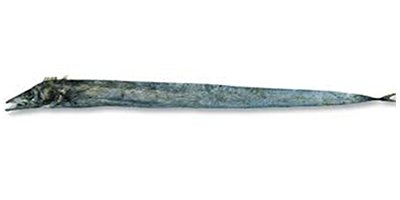
SILVER SCABBARDFISH : LEPIDOPUS CAUDATUS
Its body is very long, heavily laterally compressed, it is silvery and pearly. It differs from the other sabers by its dorsal fin which begins with 9 spiny rays slightly raised and spotted with a black color, its anal fin has two spines, the first of which is similar to a heart-shaped scale, its caudal fin is small and, its pelvic fin consists of a spiny ray that looks like a scale.
Its common length is between 50 and 150 cm, it can go up to 210 cm.
It is a benthopelagic species of the continental slope that can live for as deep as 600 m. It generally prefers sandy bottoms of 100 to 300 m and sometimes coastal areas of deep water.
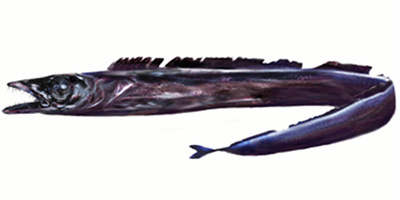
BLACK SCABBARDFISH: APHANOPUS CARBO
This species of blackish and coppery color is characterized by its dorsal fin with a clear notch in the middle. Its pelvic fins are present as a simple spine when they are young, but they disappear once completely adults.
Its common length is about 75 cm, the maximum length 114 cm.
This benthopelagic species of the continental slope lives in depths between 20 to 1600 m.